
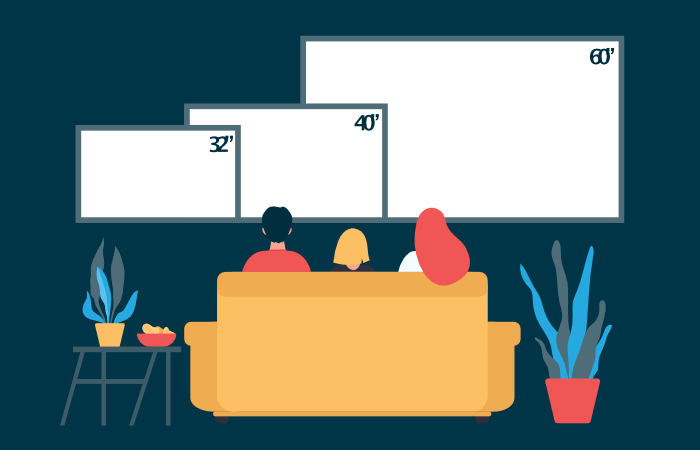
If you’re planning on getting yourself a new TV and wondering about the different sizes, this is for you. Read on to find out more about the various TV dimensions that are available.
If you’re planning on getting yourself a new TV and wondering about the different sizes, this is for you. Read on to find out more about the various TV dimensions that are available.
TV Screen Sizes: What do they mean?
The advertised screen size of a TV is the diagonal measurement of the TV screen. In other words, the length of a line would go from one corner of the screen to the opposite corner. The width and depth of a TV are usually “hidden” in the product specs and are different measurements than the advertised screen size.
The width and depth of a TV are essential factors to consider when making your purchase. The width will determine how much space the TV will take up, and the depth will affect how easy it is to mount the TV on a wall. Remember that the advertised screen size is not always accurate, as the bezel (the frame around the screen) can vary in width. A wider bezel will make the TV appear to have a larger screen.
When considering the dimensions of your TV, it is vital to consider both the advertised screen size and the actual width and depth of the unit.
That’s why we put together this helpful guide with the actual dimensions of popular TV sizes.
Does the TV bezel (the border around the screen) add to the size?
No, the bezel does not add to the size of the TV. The screen size measurement communicated by the manufacturer is always just for the screen itself and does not include the bezel.
Convert TV Dimensions: Inches to Cm
Now that we know how screen size is measured let’s talk about how to convert those measurements. Here is a handy conversion chart to help you out. Find your desired screen size in inches on the left-hand side, then look across to find the corresponding centimeters measurement.
TV Sizes Chart: Height And Width
| Size | Width | Height | Area |
|---|---|---|---|
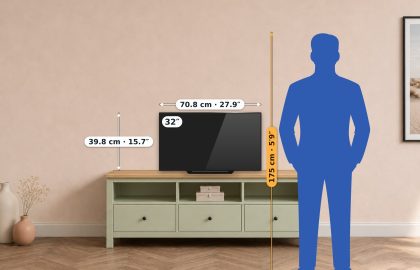
| 32″ | 27.9″ 70.9 cm | 15.7″ 39.9 cm | 438 in2 0.283 m2 |
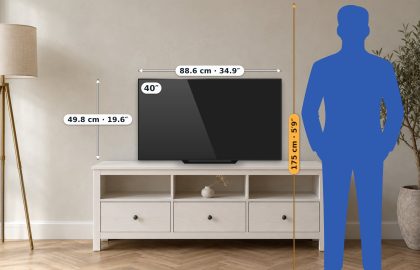
| 40″ | 34.9″ 88.6 cm | 19.6″ 49.8 cm | 684 in2 0.441 m2 |
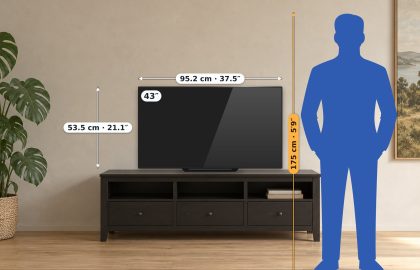
| 43″ | 37.5″ 95.3 cm | 21.1″ 53.6 cm | 791 in2 0.511 m2 |
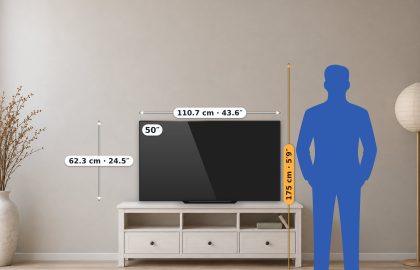
| 50″ | 43.6″ 110.7 cm | 24.5″ 62.2 cm | 1068 in2 0.689 m2 |
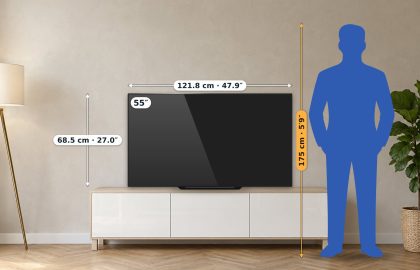
| 55″ | 47.9″ 121.7 cm | 27.0″ 68.6 cm | 1293 in2 0.835 m2 |
| 60″ | 52.3″ 132.8 cm | 29.4″ 74.7 cm | 1538 in2 0.992 m2 |
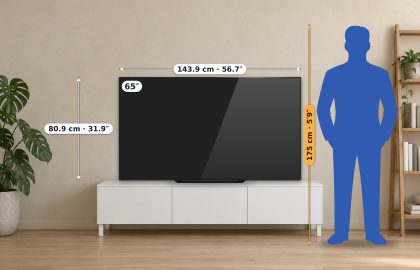
| 65″ | 56.7″ 144.0 cm | 31.9″ 81.0 cm | 1809 in2 1.166 m2 |
| 70″ | 61.0″ 154.9 cm | 34.3″ 87.1 cm | 2092 in2 1.349 m2 |
| 75″ | 65.4″ 166.1 cm | 36.8″ 93.5 cm | 2407 in2 1.553 m2 |
| 80″ | 69.7″ 177.0 cm | 39.2″ 99.6 cm | 2732 in2 1.763 m2 |
| 85″ | 74.1″ 188.2 cm | 41.7″ 105.9 cm | 3090 in2 1.993 m2 |
What Size Do You Need?
When choosing the perfect television for your home, size is an important consideration. The right TV size will depend on many factors, including the size of your room and how far away you plan to sit from the screen. In general, televisions can be divided into three categories: small (up to 32 inches), medium (33-43 inches), and large (44 inches or more).
If you have a small room or limited space, a small TV is probably the best option. Small TVs are also a good choice if you plan to sit close to the screen since they won’t overwhelm your field of vision. Medium-sized TVs are a good compromise between size and price, and they’re large enough that you can enjoy the picture from a distance. Large TVs are ideal for large rooms or watching movies and shows with friends and family. However, they’re also the most expensive option.
TV Size vs Viewing Distance
The size of your television doesn’t matter nearly as much as the distance you sit from it. To get the best viewing experience, choosing a viewing distance that is comfortable for you and provides a clear picture is essential. The following table offers some general guidelines for selecting the correct viewing distance based on the size of your TV. However, keep in mind that these are only general recommendations. The most important thing is to find a comfortable distance for you and a clear view of the screen.
Viewing Distance Chart
| Screen Size | Recommended Distance (30° Viewing Angle) |
| 25″ | 3.4′ (1.04 m) |
| 30″ | 4.1′ (1.24 m) |
| 35″ | 4.8′ (1.45 m) |
| 40″ | 5.5′ (1.66 m) |
| 45″ | 6.1′ (1.86 m) |
| 50″ | 6.8′ (2.06 m) |
| 55″ | 7.5′ (2.28 m) |
| 60″ | 8.2′ (2.48 m) |
| 65″ | 8.9′ (2.69 m) |
| 70″ | 9.5′ (2.9 m) |
| 75″ | 10.2′ (3.1 m) |
| 80″ | 10.9′ (3.31 m) |
| 85″ | 11.6′ (3.52 m) |
These distances are based on a screen size calculation and viewing angle recommended by the Society of Motion Picture and Television Engineers (SMPTE). They recommend sitting at a distance where the screen fills up a minimum of 30° of your field of vision for a good experience.
Sources:
https://www.rtings.com/tv/reviews/by-size/size-to-distance-relationship
https://en.wikipedia.org/wiki/Field_of_view
https://www.coolblue.nl/en/advice/what-is-the-size-of-my-tv.html
Very helpful, thank you.